Through Many Tribulations
Acts 14:1-28
Key Verse 22: Strengthening the souls of the disciples, encouraging them to continue in the faith, and saying that through many tribulations we must enter the kingdom of God.
Theme: As you sent me into the world, so I have sent them into the world. -John 17:18
Note: There are two cities named Antioch - Map Of Paul’s First Missionary Journey
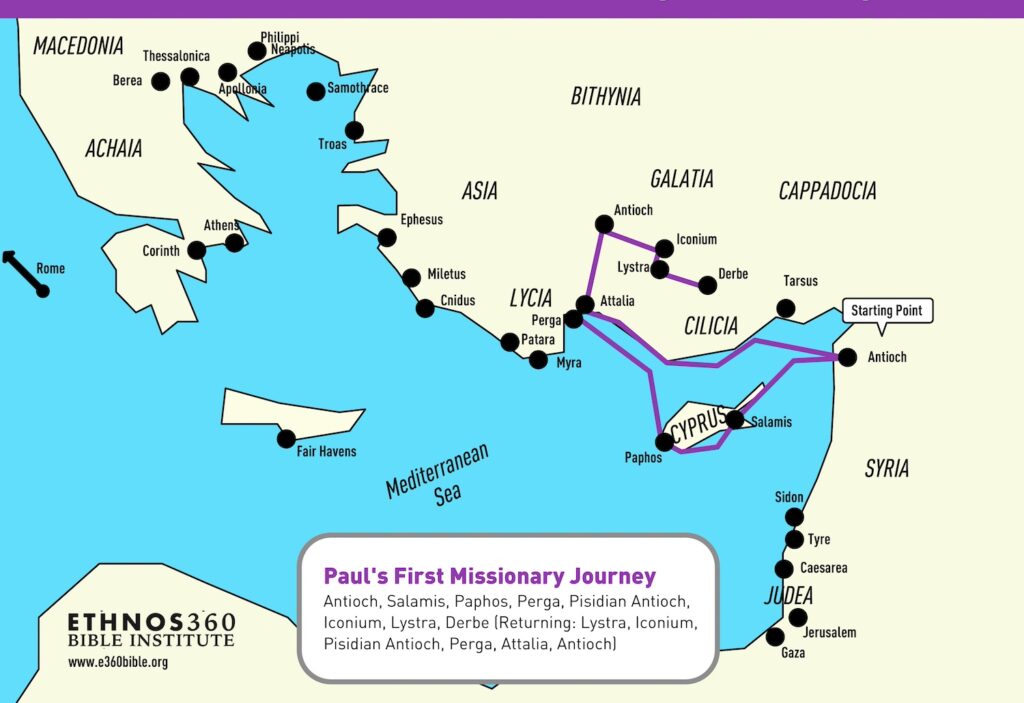
Introduction:
Great work of God met with the terrible work of opposition. But God works through the persecution. So the key verse teaches the core of Christian life, “through many tribulations, we must enter the kingdom of God.” Jesus entered the kingdom of God through his death on the cross. All Christians are in Christ and follow the same truth. Today’s passage teaches a very vivid picture of Christian life through death and resurrection. Paul was presumed dead and rose again from the dead.
-
-
-
V1-7 Iconium
Now at Iconium they entered together into the Jewish synagogue and spoke in such a way that a great number of both Jews and Greeks believed. 2 But the unbelieving Jews stirred up the Gentiles and poisoned their minds against the brothers. 3 So they remained for a long time, speaking boldly for the Lord, who bore witness to the word of his grace, granting signs and wonders to be done by their hands. 4 But the people of the city were divided; some sided with the Jews and some with the apostles. 5 When an attempt was made by both Gentiles and Jews, with their rulers, to mistreat them and to stone them, 6 they learned of it and fled to Lystra and Derbe, cities of Lycaonia, and to the surrounding country, 7 and there they continued to preach the gospel.
-
What were Paul and Barnabus doing at Iconium? What impact did their speaking have? (1b, 2) What did they do after being persecuted, and how did God bear witness to the word of his grace? (3) Why should we follow this pattern when we encounter persecution?
-
What were Paul and Barnabus doing at Iconium?
“They entered together into the Jewish synagogue and spoke in such a way that a great number of both Jews and Greeks believed.” They worked together and there was a great work of God from both Jews and Greeks. They were kicked out of Antioch, but now here there was a great work of God.
-
What impact did their speaking have? (1b, 2)
A great number of both Jews and Greeks believed. 2 “But the unbelieving Jews stirred up the Gentiles and poisoned their minds against the brothers.” Great work of God followed by persecution.
-
What did they do after being persecuted, and how did God bear witness to the word of his grace? (3)
3 “So they remained for a long time, speaking boldly for the Lord, who bore witness to the word of his grace, granting signs and wonders to be done by their hands.”
Despite underlying work of poisoning the minds of believers, Paul and Barnabas remained for a long time, speaking boldly. The Lord answered their faith and boldness through signs and wonders. Signs and wonders could be miraculous healing.
-
Why should we follow this pattern when we encounter persecution?
We should not be discouraged when persecution comes because there can be a great work of God despite persecution. In a way, God works through persecutions.
-
-
-
V8-20 Lystra
8 Now at Lystra there was a man sitting who could not use his feet. He was crippled from birth and had never walked. 9 He listened to Paul speaking. And Paul, looking intently at him and seeing that he had faith to be made well, 10 said in a loud voice, “Stand upright on your feet.” And he sprang up and began walking. 11 And when the crowds saw what Paul had done, they lifted up their voices, saying in Lycaonian, “The gods have come down to us in the likeness of men!” 12 Barnabas they called Zeus, and Paul, Hermes, because he was the chief speaker. 13 And the priest of Zeus, whose temple was at the entrance to the city, brought oxen and garlands to the gates and wanted to offer sacrifice with the crowds. 14 But when the apostles Barnabas and Paul heard of it, they tore their garments and rushed out into the crowd, crying out, 15 “Men, why are you doing these things? We also are men, of like nature with you, and we bring you good news, that you should turn from these vain things to a living God, who made the heaven and the earth and the sea and all that is in them. 16 In past generations he allowed all the nations to walk in their own ways. 17 Yet he did not leave himself without witness, for he did good by giving you rains from heaven and fruitful seasons, satisfying your hearts with food and gladness.” 18 Even with these words they scarcely restrained the people from offering sacrifice to them.
Paul Stoned at Lystra
19 But Jews came from Antioch and Iconium, and having persuaded the crowds, they stoned Paul and dragged him out of the city, supposing that he was dead. 20 But when the disciples gathered about him, he rose up and entered the city, and on the next day he went on with Barnabas to Derbe.
-
What did Paul and Barnabus do at Lystra? What impact did their speaking have? (8-10) Why do you think the crowd behaved the way that they did and why didn't they believe Paul's words?
What did Paul and Barnabus do at Lystra?
Preaching, speaking. Verse 9 says “the crippled man listened to Paul speaking.” So Paul and Barnabas preaching to the Gentiles in the Gentile city of Lystra
What impact did their speaking have? (8-10)
8 “Now at Lystra there was a man sitting who could not use his feet. He was crippled from birth and had never walked. 9 He listened to Paul speaking. And Paul, looking intently at him and seeing that he had faith to be made well, 10 said in a loud voice, “Stand upright on your feet.” And he sprang up and began walking.”
A crippled man from birth was healed. Paul did not mention about Jesus’ name. There is a possibility to preach the gospel according to their knowledge without mentioning Jesus.
-
Why do you think the crowd behaved the way that they did and why didn't they believe Paul's words?
The crowd could not get out of their idol-worshipping mentality. They were worshiping many gods. When they saw the healing of the crippled man, they thought Paul and Barnabas were gods who had become men.
They could not believe Paul’s words because they believed their own idea of idol worship.
By the way, Paul did not teach Jesus’ death and resurrection to the crowds who wanted to worship them. Through verses 15-17, he taught only the living God who created the heavens and the earth and everything in them. He told them God left a witness, and it was his nature. He preached based on natural revelation because they were not exposed to the Scriptures or Jewish belief.
-
-
-
V19-21a Derbe
19 But Jews came from Antioch and Iconium, and having persuaded the crowds, they stoned Paul and dragged him out of the city, supposing that he was dead. 20 But when the disciples gathered about him, he rose up and entered the city, and on the next day he went on with Barnabas to Derbe. 21 When they had preached the gospel to that city and had made many disciples,
-
What happened to Paul? (19) What did he do next? (20-21) How does this example help us continue to speak with boldness no matter what happens?
-
What happened to Paul? (19)
19 “”But Jews came from Antioch and Iconium, and having persuaded the crowds, they stoned Paul and dragged him out of the city, supposing that he was dead.”
The persecutors from unbelieving Jews from Antioch were persistent. They almost walked 100 miles to persecute Paul. Together with unbelieving Jews from Iconium, they persuaded the crowds and stoned Paul. The crowds were the ones who thought Paul and Barnabas were gods. Now they changed so quickly.
-
What did he do next? (20-21)
20 “But when the disciples gathered about him, he rose up and entered the city, and on the next day he went on with Barnabas to Derbe. 21 When they had preached the gospel to that city and had made many disciples, they returned to Lystra and to Iconium and to Antioch,”
He resurrected and went back to the city. He left Lystra on his own terms. Lystra is the place where Timothy and his mother are from. What happened to Paul could have impacted Timothy and his mother.
Later, Paul’s confession to see 3rd heaven might be related to this time of experience.
-
How does this example help us continue to speak with boldness no matter what happens?
We should not stop preaching because of persecution. Resurrection faith can help us to be bold and overcome fear.
-
-
-
V21b-28
they returned to Lystra and to Iconium and to Antioch, 22 strengthening the souls of the disciples, encouraging them to continue in the faith, and saying that through many tribulations we must enter the kingdom of God. 23 And when they had appointed elders for them in every church, with prayer and fasting they committed them to the Lord in whom they had believed.
Paul and Barnabas Return to Antioch in Syria
24 Then they passed through Pisidia and came to Pamphylia. 25 And when they had spoken the word in Perga, they went down to Attalia, 26 and from there they sailed to Antioch, where they had been commended to the grace of God for the work that they had fulfilled. 27 And when they arrived and gathered the church together, they declared all that God had done with them, and how he had opened a door of faith to the Gentiles. 28 And they remained no little time with the disciples.
-
What did Paul and Barnabus communicate to all the churches on their return trip? Why was this message important for the churches to receive at this time?
-
What did Paul and Barnabus communicate to all the churches on their return trip?
22 “strengthening the souls of the disciples, encouraging them to continue in the faith, and saying that through many tribulations we must enter the kingdom of God. 23 And when they had appointed elders for them in every church, with prayer and fasting they committed them to the Lord in whom they had believed.”
They went back to all the towns where they had preached. They were not afraid of persecution.
They strengthened their souls, encouraging them to continue in the faith. (Probably they were taught only a few weeks) and taught them “Through many tribulations we must enter the kingdom of God.” Paul and Barnabas prepared them for the coming persecution that they might stand firm at the time of persecution.
We cannot avoid the cross to enter the kingdom of God. We should endure (Hebrews 11:3) as Jesus did. This is the principle of the gospel, which means, through many tribulations we must enter the kingdom of God” applies to all Christians.
Even though in such a short time, they appointed elders through prayer and establish church structure for them.
Ultimately, they committed them to the Lord whom they have believed. Only the Lord can sustain them not Paul or Barnabas.
-
Why was this message important for the churches to receive at this time?
Probably, they would be exposed to persecution after Paul and Barnabas left. If they know such principles and the truth of the gospel, they would not be surprised but stand firm in the faith. Jesus also said, “18 If the world hates you, know that it has hated me before it hated you. 19 If you were of the world, the world would love you as its own; but because you are not of the world, but I chose you out of the world, therefore the world hates you.” (John 15:18-19)
Copyright © 2026 LA UBF All rights reserved.